
Best Controls for Silica Exposure on Site

A worker dry-cutting fibre cement beside a public footpath can create a serious silica risk in minutes. The best controls for silica exposure are not a mask handed out at pre-start. They are planned decisions about material selection, work methods, plant, supervision and verification before dust is generated.
Respirable crystalline silica is released when materials such as engineered stone, concrete, fibre cement, bricks, tiles and some natural stone are cut, drilled, chased, ground or demolished. The respirable fraction is invisible to the naked eye and can travel beyond the immediate task area. That is why a visibly dusty job is already a control failure, not simply an inconvenience to clean up later.
For Australian business owners, directors and site managers, silica control needs to work on two levels. It must protect workers and others who may be exposed, while also standing up to regulator scrutiny, client audits and tender requirements. A generic safe work method statement will not achieve either outcome if the equipment, training and site conditions do not match the document.
Start with the hierarchy of control
The most effective silica controls remove the hazard or isolate it at the source. Personal protective equipment is necessary for some work, but it sits at the bottom of the hierarchy. It should never be the principal answer where higher-order controls are reasonably practicable.
Eliminate or substitute the silica-generating task
First ask whether the work needs to create dust at all. Can components be ordered to size, precast off site under controlled conditions, or fixed using an alternative method? Can a lower-silica product be specified? These questions are particularly valuable at design, procurement and quoting stages, when the cost of changing the method is lowest.
Engineered stone has been prohibited in Australia since 1 July 2024, subject to limited jurisdiction-specific exceptions. Businesses involved in renovation, removal, disposal or legacy work should confirm their obligations under the laws that apply in their state or territory rather than treating the prohibition as a simple product substitution exercise.
Substitution has limits. A product may contain less silica but introduce another health, environmental or performance issue. Procurement controls should therefore require safety data, product composition where available, and approval of any alternative material before it reaches site.
Use wet methods at the point of dust generation
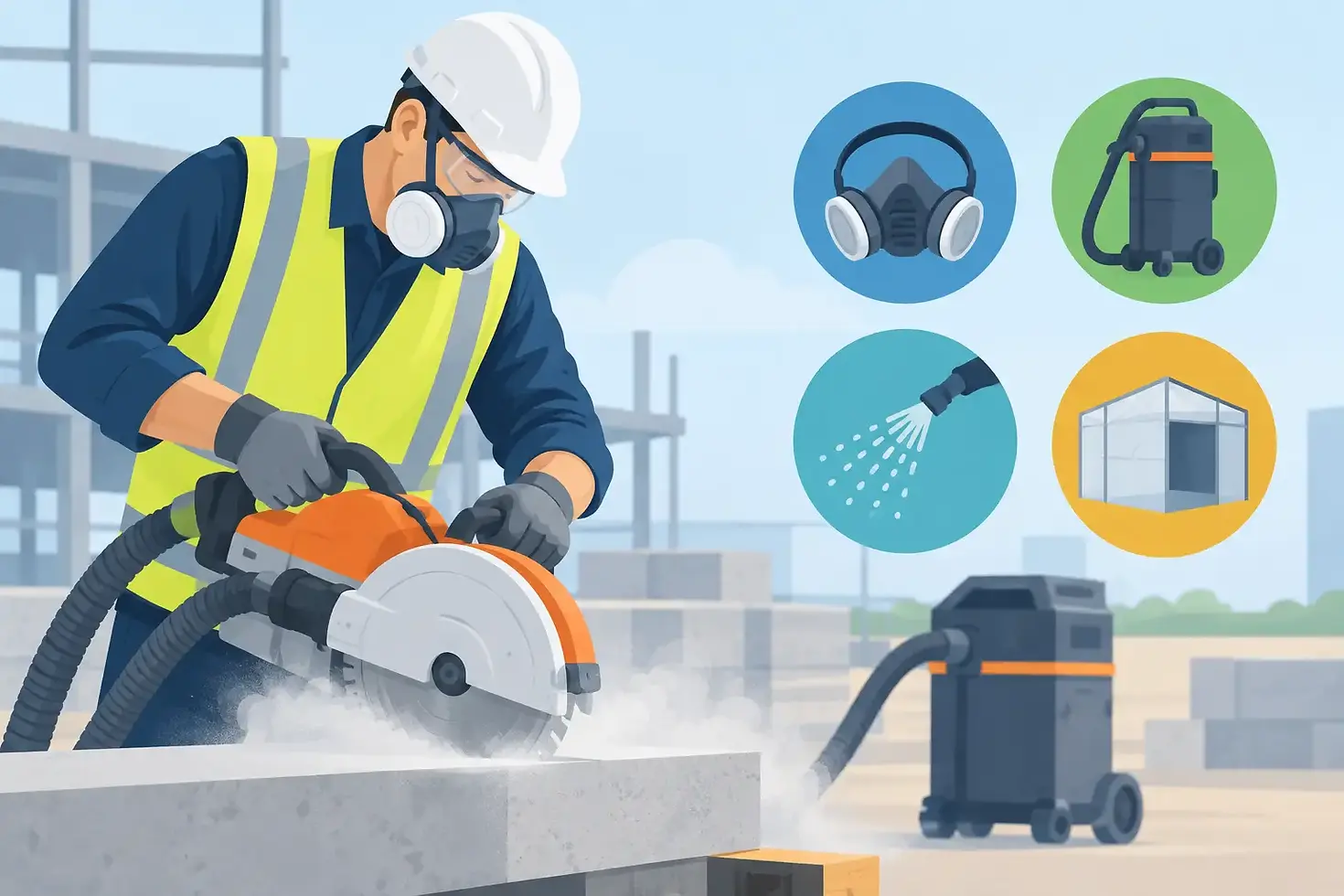
Where cutting or drilling cannot be avoided, water suppression is often the most practical engineering control. The key is delivering sufficient water directly to the blade, bit or grinding point before and during the task. A hose pointed generally at the work area is not an adequate system.
Wet cutting saws, water-fed grinders and drilling equipment with integrated water delivery reduce airborne dust substantially when they are maintained and used correctly. They also create slurry. The job plan must cover collection and disposal so slurry does not dry out, enter stormwater, create a slip hazard or become dust again during clean-up.
Water is not suitable for every task. Electrical risks, access constraints, freezing conditions in some locations, and manufacturer instructions may affect its use. Where wet methods are not practicable, the reason should be documented and a suitable on-tool extraction method selected.
Capture dust with local exhaust extraction
Local exhaust ventilation captures dust close to its source before it enters the worker's breathing zone. For handheld tools, that usually means a shroud connected to a correctly rated dust extractor. The extractor needs adequate airflow, compatible hoses and fittings, effective filtration, and a maintenance regime that keeps it operating as designed.
A domestic vacuum cleaner is not a silica control. Neither is a dust extractor with a blocked filter, damaged hose or missing shroud. Specify plant that is suitable for hazardous dust, inspect it before use, and record periodic servicing. Workers also need clear instructions on filter cleaning because shaking, blowing out or dry-brushing filters can create a second exposure event.
For fixed cutting benches, enclosed booths or purpose-built extraction systems may be more appropriate. These systems require commissioning, regular checks and review when production volumes, materials or layouts change. Extraction that worked in a workshop last year may not be adequate after a new saw, altered ducting or increased throughput is introduced.
Control the work area, not just the operator
Silica exposure is rarely confined to the person holding the tool. Labourers, electricians, supervisors, other trades and members of the public may be exposed if the work is poorly planned. Establish a clearly defined exclusion zone, prevent unnecessary access, and schedule high-dust activities away from other work where possible.
For enclosed or partially enclosed areas, assess ventilation before starting. Natural ventilation is unpredictable and should not be relied on as the sole control for high-dust work. Consider whether the task can be moved outdoors, whether temporary extraction is needed, and how dust migration into occupied areas will be prevented.
Housekeeping matters because settled dust can be made airborne again by foot traffic, compressed air, dry sweeping or ordinary vacuuming. Use wet wiping, wet mopping where appropriate, or a suitable H-class vacuum. Do not allow workers to use compressed air on clothing, benches or plant. Contaminated workwear should be managed so dust is not carried into vehicles, lunchrooms or homes.
Respiratory protection is the last line, not the whole plan
Respiratory protective equipment may be needed while higher-order controls are in place, during short-duration tasks, for maintenance, or where residual exposure remains. Selection should be based on the task, expected exposure, fit, work rate and other site conditions. Disposable P2 respirators may be suitable for some limited tasks, but they can be a poor practical choice for sustained cutting, hot environments or workers with facial hair.
A tight-fitting respirator only protects when it seals to the face. Workers require fit testing, training in seal checks, cleaning and storage, and supervision to ensure the respirator is worn when dust is present. Facial hair in the seal area prevents an effective fit. Where workers cannot wear tight-fitting masks, consider suitable alternative respiratory protection and obtain competent advice.
PPE records should show more than a purchase order. Keep the make and model issued, fit-test results, user training, inspection arrangements and replacement process. These details matter when demonstrating that the control was implemented, not merely nominated in a risk assessment.
Build silica controls into your WHS system
Australian WHS duties require businesses to identify hazards, assess risks where necessary, implement controls and review whether those controls work. For silica work, this should translate into task-specific documentation and site practice, not a broad statement that workers must "wear PPE".
A practical silica risk assessment identifies the material, the silica-generating activity, the workers and others at risk, likely exposure duration, selected controls, equipment requirements, exclusion arrangements, clean-up method and person responsible for supervision. If a job changes, the assessment must change with it. A revised scope, a different tool or a move from open air to an internal area can materially alter the risk.
Where the relevant WHS regulations apply, businesses may also need a silica risk control plan for high-risk crystalline silica work. Requirements differ by jurisdiction and task, so confirm the rules that apply to the work location. This is an area where a competent WHS review can prevent a costly gap between national guidance, state-based requirements and actual site practice.
Verify that controls are working
The workplace exposure standard for respirable crystalline silica is very low: 0.05 mg/m³ as an eight-hour time-weighted average. Exposure monitoring may be required where there is uncertainty about whether the standard is exceeded, and it is a sensible verification tool for higher-risk or repeated work. Monitoring should be planned and interpreted by a competent occupational hygienist.
Do not wait for monitoring results to install basic controls. Monitoring verifies the effectiveness of the chosen method; it does not justify avoidable exposure while a business decides what to do. Review results alongside observations of worker behaviour, equipment condition, maintenance records, complaints, dust incidents and health surveillance obligations.
Managers should routinely ask simple operational questions: Is water reaching the cutting point? Is the shroud fitted? Is extraction drawing properly? Is anyone dry sweeping? Are other trades entering the exclusion zone? These checks provide faster assurance than a folder of signed forms.
For businesses seeking ISO 45001 alignment or stronger tender readiness, silica controls should connect to procurement, contractor management, training, inspections, corrective actions and internal audits. The Safety Hand commonly sees the strongest results where the system makes the safe method the easiest method to follow on site.
A silica control plan earns its value when the worker under time pressure can still set up the right tool, contain the area and complete the task without creating a cloud of dust. That is the standard worth designing for.


Comments